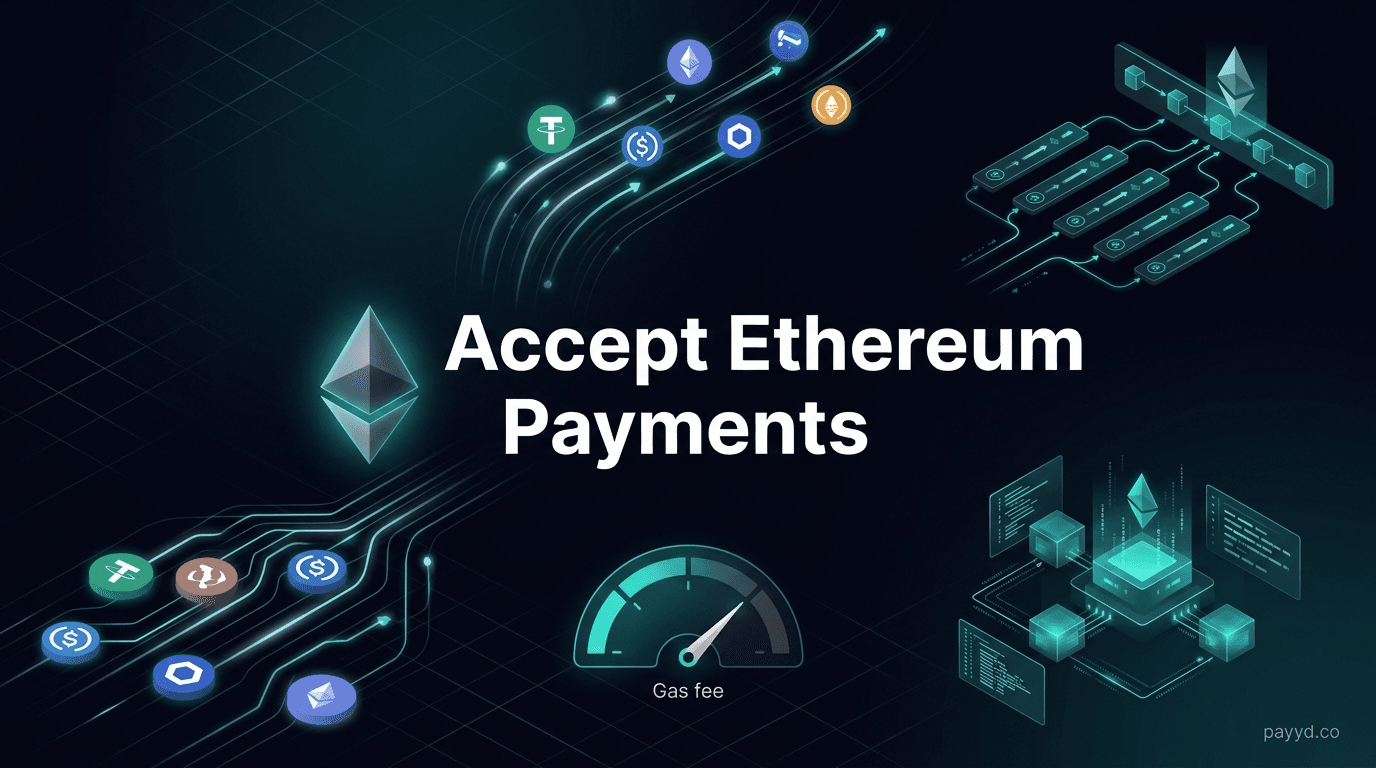
How to Accept Ethereum Payments: ETH, ERC-20 Tokens & Layer 2s
Guide to accepting Ethereum payments. ETH vs ERC-20 tokens (USDT, USDC), gas fee management, Layer 2s (Polygon, Arbitrum, Optimism), and which gateways support Ethereum best.
Key Takeaways
- Ethereum is not just ETH — the real volume is in ERC-20 tokens like USDT and USDC. Accepting Ethereum means accepting its entire token ecosystem
- Ethereum mainnet gas fees ($2-20 per transaction) make it expensive for small payments — use Layer 2s (Polygon, Arbitrum, Optimism) for fees under $0.10
- Most crypto gateways support Ethereum and ERC-20 tokens. NOWPayments and ATLOS have the broadest Ethereum ecosystem support including L2 networks
- Smart contract payments on Ethereum enable programmable billing, escrow, and automated revenue splitting — capabilities impossible with Bitcoin
Ethereum is the second-largest cryptocurrency and the backbone of decentralized finance. But for merchants, the real value of accepting Ethereum is not just ETH itself — it is access to the entire ERC-20 token ecosystem. When you accept Ethereum payments, you can accept USDT, USDC, DAI, and thousands of other tokens running on the Ethereum network.
There is a catch, though: gas fees. Ethereum mainnet transactions can cost $2-20 depending on network congestion, making small payments impractical on Layer 1. This guide shows you how to accept Ethereum efficiently — using L2 networks for cheap transactions while still tapping into the Ethereum ecosystem's massive user base.
Why Accept Ethereum Payments?
- Second-largest crypto by market cap. Millions of people hold ETH and ERC-20 tokens. By accepting Ethereum, you open your business to the largest smart contract ecosystem in crypto
- Stablecoin dominance. The majority of USDT and USDC circulation is on Ethereum and its L2s. Accepting Ethereum means accepting the most popular stablecoins
- DeFi integration. Ethereum's smart contract capabilities enable programmable payments: automatic billing, escrow, revenue splitting, and conditional payments
- NFT and Web3 audiences. If your customers are in the NFT, gaming, or Web3 space, they transact primarily on Ethereum. Not accepting ETH means missing this audience entirely
- Multi-chain L2 ecosystem. Polygon, Arbitrum, Optimism, and Base are all Ethereum Layer 2s — they share the same wallet addresses and token standards, making integration seamless
ETH vs ERC-20 Tokens: What You Are Actually Accepting
When I say "accept Ethereum payments," I mean two things:
1. ETH (Ether) — the native currency
ETH is Ethereum's native token, used to pay gas fees and as a store of value. Accepting ETH is like accepting Bitcoin — it is a volatile asset that can fluctuate in price. Most crypto-holding customers have some ETH in their wallet.
2. ERC-20 tokens — tokens running on Ethereum
ERC-20 is a token standard that allows any project to create a token on Ethereum. The most important ones for merchants:
For merchants, accepting ERC-20 stablecoins (USDT, USDC) is often more valuable than accepting ETH itself, because you receive dollar-pegged value without volatility risk. For more on stablecoin payments, see our stablecoin payments guide.
Understanding Gas Fees (and How to Minimize Them)
Gas is the fee you pay to use the Ethereum network. Every transaction — whether sending ETH or an ERC-20 token — requires gas. Gas prices fluctuate based on network demand.
Typical Ethereum mainnet gas costs (2026):
- Simple ETH transfer: $2-5
- ERC-20 token transfer (USDT, USDC): $3-10
- Smart contract interaction: $5-20
- During network congestion: 2-5x higher
Who pays gas? The sender (your customer) pays gas fees. However, high gas fees discourage customers from making small purchases. If a customer wants to buy a $10 product and gas costs $8, that transaction is dead.
How to minimize gas impact:
- Accept payments on Layer 2 networks — Polygon, Arbitrum, and Optimism have fees under $0.10
- Set a minimum order amount for Ethereum mainnet — $50+ makes the gas fee proportionally small
- Use gas-efficient token standards — USDT on Tron (TRC-20) is cheaper than on Ethereum (ERC-20)
- Accept multiple networks — let customers choose the cheapest option at checkout
Layer 2 Networks: Polygon, Arbitrum, Optimism
Layer 2 (L2) networks are the practical solution to Ethereum's gas fee problem. They process transactions off the main Ethereum chain while inheriting its security:
The key advantage of L2s: your customers use the same wallet (MetaMask) and the same tokens (USDT, USDC) — they just switch the network. From a merchant perspective, accepting Polygon USDC is identical to accepting Ethereum USDC, just 100x cheaper for your customer.
Best Gateways for Ethereum Payments
- NOWPayments — Supports ETH, all major ERC-20 tokens, and L2 networks including Polygon and Arbitrum. Auto-conversion available. Best all-round for Ethereum payments
- ATLOS — 11 blockchain networks including Ethereum mainnet, Polygon, Arbitrum, Optimism, and BSC. DAO-governed, non-custodial. Best for multi-chain Ethereum ecosystem support
- Coinremitter — Supports ETH and ERC-20 tokens on mainnet. 0.23% fees, no KYC. Best for cheapest hosted ETH processing
- BoomFi — Ethereum and Polygon support with smart contract billing for subscriptions. Best for SaaS businesses on Ethereum
- BTCPay Server — Ethereum support via NBXplorer. Free but requires self-hosting. ETH support is not as mature as BTC support
Smart Contract Payments on Ethereum
Ethereum's programmability opens up payment patterns that Bitcoin simply cannot do:
- Token approvals for subscriptions: A customer can approve a smart contract to deduct a fixed amount monthly. No card expiration, no failed payments. BoomFi uses this model for crypto subscription billing
- Escrow payments: A smart contract holds payment until both parties confirm delivery. No escrow service needed — the code is the arbiter
- Automatic revenue splits: Incoming payments automatically split between multiple wallets — marketplace platforms, partnership revenue, or affiliate commissions
- Conditional releases: Payment only releases when an on-chain oracle confirms delivery, a time lock expires, or multiple signers approve
For more on Web3 payment patterns, see our Web3 payment gateways guide.
How to Start Accepting Ethereum Payments
- Set up a wallet. MetaMask is the standard for Ethereum. Install the browser extension or mobile app. Write down your seed phrase and store it securely
- Add L2 networks. In MetaMask, add Polygon, Arbitrum, and Optimism networks. This lets you receive payments on any of these chains using the same address
- Choose a gateway. NOWPayments for easy setup, ATLOS for multi-chain non-custodial, or BoomFi for subscription billing
- Configure accepted tokens. At minimum, enable: ETH, USDT, USDC on Ethereum and Polygon. Add Arbitrum and Optimism if your audience uses them
- Integrate. Add the payment button, checkout widget, or API integration to your site
- Test on testnet. Most gateways support Ethereum testnets (Sepolia, Goerli). Send a test payment before going live
- Announce. Add "We accept ETH, USDT, USDC" to your checkout, footer, and marketing materials
Accept ETH, USDT, USDC & More
The Ethereum ecosystem is massive. Tap into it with a crypto payment gateway that supports ETH and all major tokens.
Compare Ethereum Gateways →Frequently Asked Questions
Are Ethereum gas fees too high for payments?
On mainnet, gas fees make transactions under $50 impractical. The solution is Layer 2 networks: Polygon and Arbitrum process the same tokens (USDT, USDC) for under $0.10 per transaction. Always offer L2 options alongside mainnet.
What is the difference between ETH and ERC-20 tokens?
ETH is Ethereum's native currency, used to pay gas fees. ERC-20 tokens (USDT, USDC, DAI) are tokens that run ON the Ethereum network but are issued by separate projects. Both are accepted through the same wallet (MetaMask) and the same payment gateways.
Can I accept Ethereum with MetaMask directly?
Technically yes — you can share your MetaMask address and customers can send you ETH or tokens. But without a payment gateway, you have no invoicing, no order matching, no notifications, and no conversion. A gateway automates all of this.
Which is better for payments: Polygon or Arbitrum?
Both are excellent. Polygon has lower fees (sub-cent) and wider gateway support. Arbitrum has slightly higher fees ($0.01-0.10) but closer security ties to Ethereum mainnet. If you had to pick one L2, Polygon has the most merchant-facing infrastructure.
Do I need to pay gas fees as a merchant?
No. The customer (sender) pays gas fees on their transaction. You only pay gas if you later move or convert the received tokens. For non-custodial gateways, the funds arrive in your wallet and you pay gas only when you spend or transfer them.
Can I auto-convert ETH to stablecoins?
Yes. NOWPayments and other custodial gateways offer auto-conversion — incoming ETH is immediately converted to USDT or USDC. This eliminates ETH price volatility while still accepting it as a payment option for your customers.