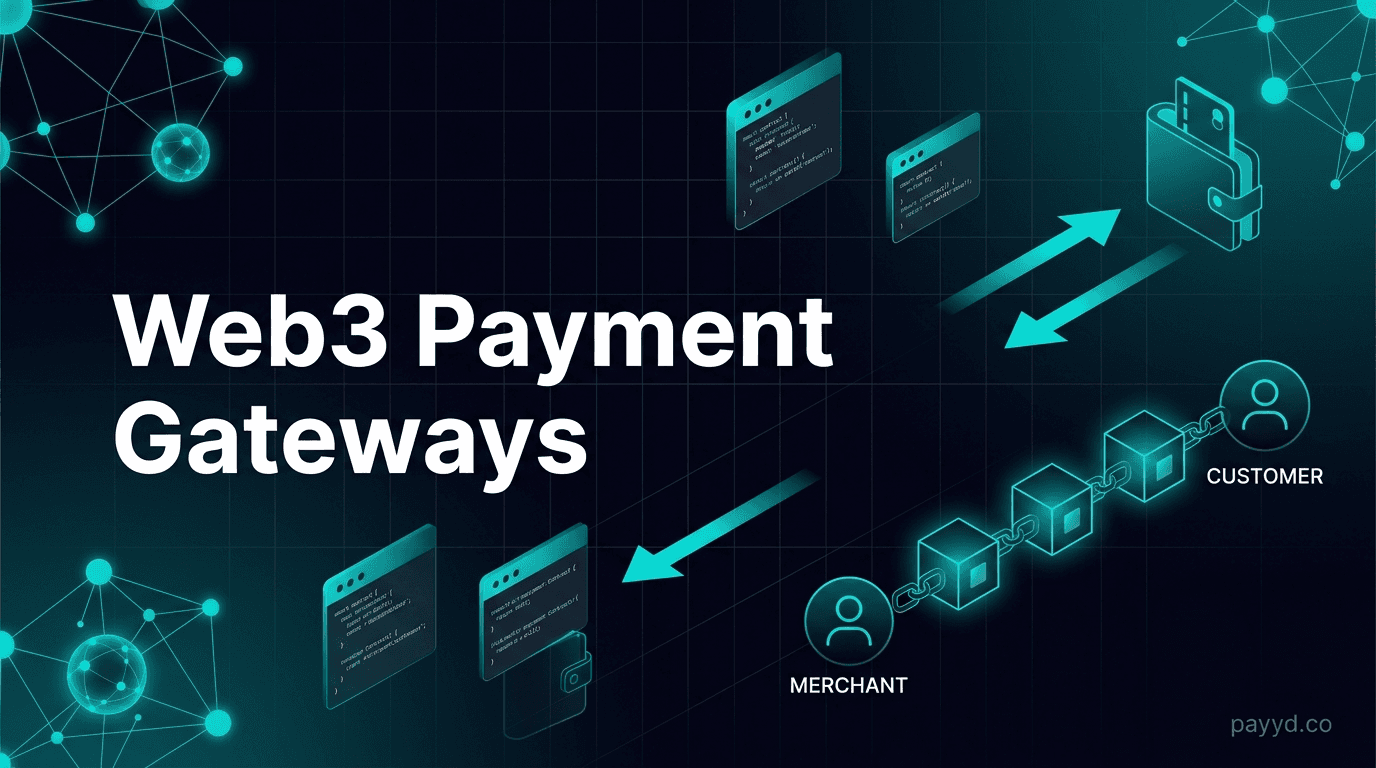
Web3 Payment Gateways 2026: Decentralized Crypto Payment Processing
Web3 payment gateways let you accept crypto without intermediaries. Compare non-custodial, on-chain solutions from BTCPay Server, ATLOS, Coinremitter, and more.
Key Takeaways
- A "Web3" payment gateway is non-custodial, permissionless, and settles on-chain — no intermediary ever holds your funds
- BTCPay Server is the gold standard: open-source, self-hosted, zero fees. ATLOS and Coinremitter offer managed alternatives with non-custodial architecture
- The trade-off vs centralized gateways: you get sovereignty and censorship resistance, but lose fiat settlement, chargebacks, and managed compliance
- Multi-chain support matters: the best Web3 gateways support Ethereum, BSC, Polygon, Arbitrum, and other L2s to minimize gas fees
"Web3 payment gateway" gets thrown around a lot, and honestly, most of the time it is marketing nonsense. A payment gateway that holds your funds in their custodial wallet and requires KYC is not Web3 — it is just a crypto-themed PayPal.
A real Web3 payment gateway has three non-negotiable properties: it is non-custodial (your funds go directly to your wallet), it is permissionless (no application process, no account freezes), and it settles on-chain (verifiable by anyone). This guide covers the gateways that actually meet these criteria and compares them to centralized alternatives so you can make an informed choice.
What Makes a Gateway "Web3"?
Let me be specific about what separates a Web3 payment gateway from a traditional crypto gateway. These are the defining characteristics:
Non-Custodial Architecture
The gateway never holds your money. Payments go directly from the customer's wallet to yours. The gateway facilitates the transaction (generating addresses, tracking confirmations, sending webhooks) but never takes custody of the funds. This eliminates counterparty risk entirely — the gateway cannot freeze, seize, or lose your money.
Permissionless Access
Anyone can use the gateway without applying, being approved, or passing a compliance review. There is no "high-risk merchant" category, no rolling reserves, and no account termination. You connect your wallet and start accepting payments.
On-Chain Settlement
Every transaction is recorded on a public blockchain. This provides transparent, auditable records that do not depend on the gateway's internal database. If the gateway company disappears tomorrow, your transaction history exists on-chain.
Open Source (Ideally)
The strongest Web3 gateways publish their code. You can audit it, fork it, and self-host it. BTCPay Server is the prime example. Open source is not strictly required to be "Web3," but it adds a layer of trust that proprietary solutions cannot match.
Top Web3 Payment Gateways Ranked
Here are the gateways that genuinely qualify as Web3, ranked by how well they deliver on the promises above.
1. BTCPay Server — The Gold Standard
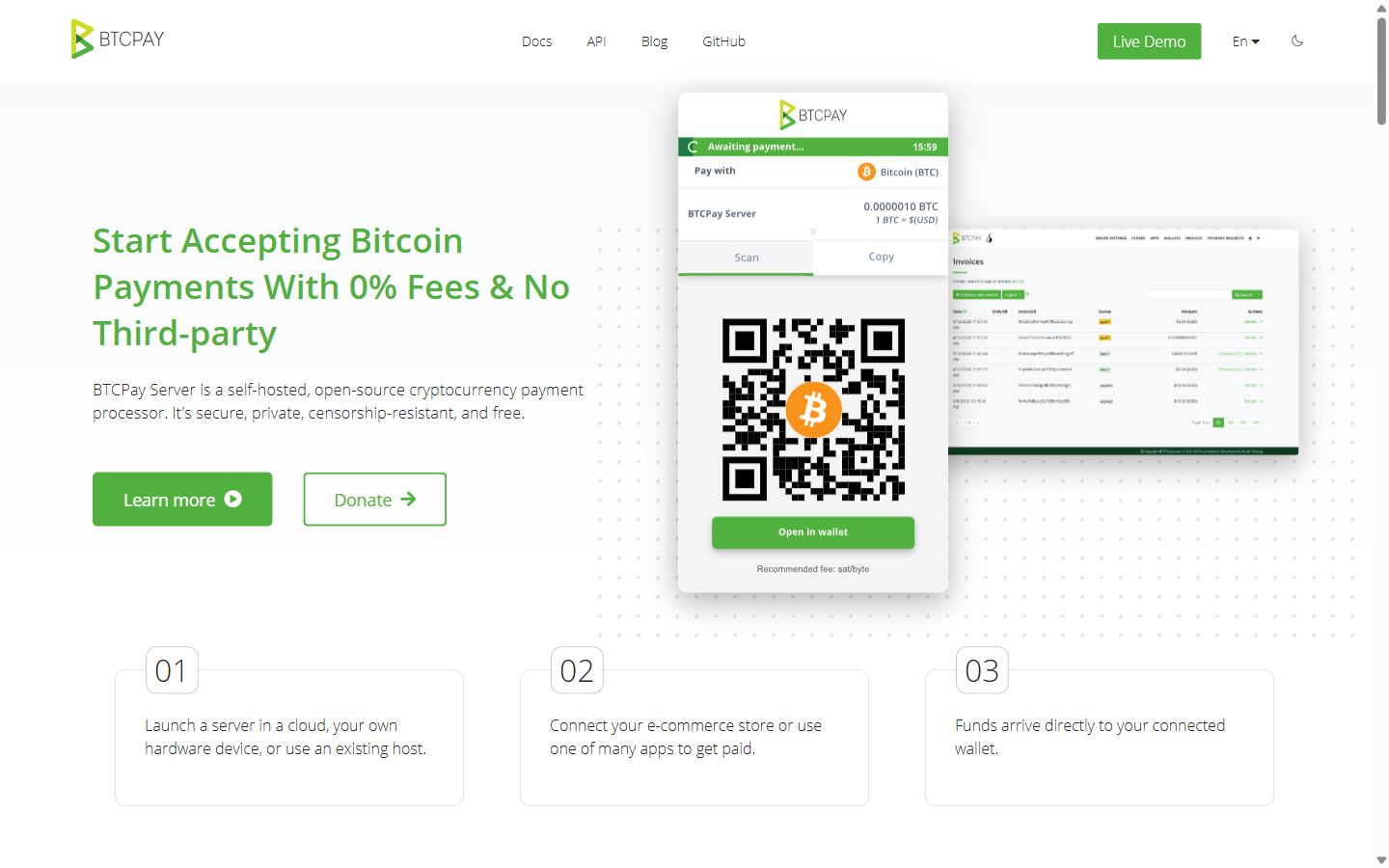
BTCPay Server is what every Web3 payment gateway aspires to be. It is fully open-source (MIT license), self-hosted, charges zero processing fees, requires zero KYC, and gives you complete control over your payment infrastructure. Payments go directly to your wallet through your own node.
The project was born from frustration with BitPay's centralization. Nicolas Dorier famously tweeted "This is lies, my trust in you is mass-dropping" at BitPay and then built BTCPay Server as the decentralized alternative. It now processes millions in payments monthly.
The trade-off is technical complexity. You need to run a server, maintain a Bitcoin node, and handle Lightning channel management if you want instant payments. For developers and tech-savvy businesses, this is trivial. For a coffee shop owner, it is a barrier. Check our open-source gateway comparison for alternatives.
Why it is #1: Zero fees, fully open source, truly non-custodial, battle-tested for years, active development community.
2. ATLOS — Best Managed Web3 Gateway
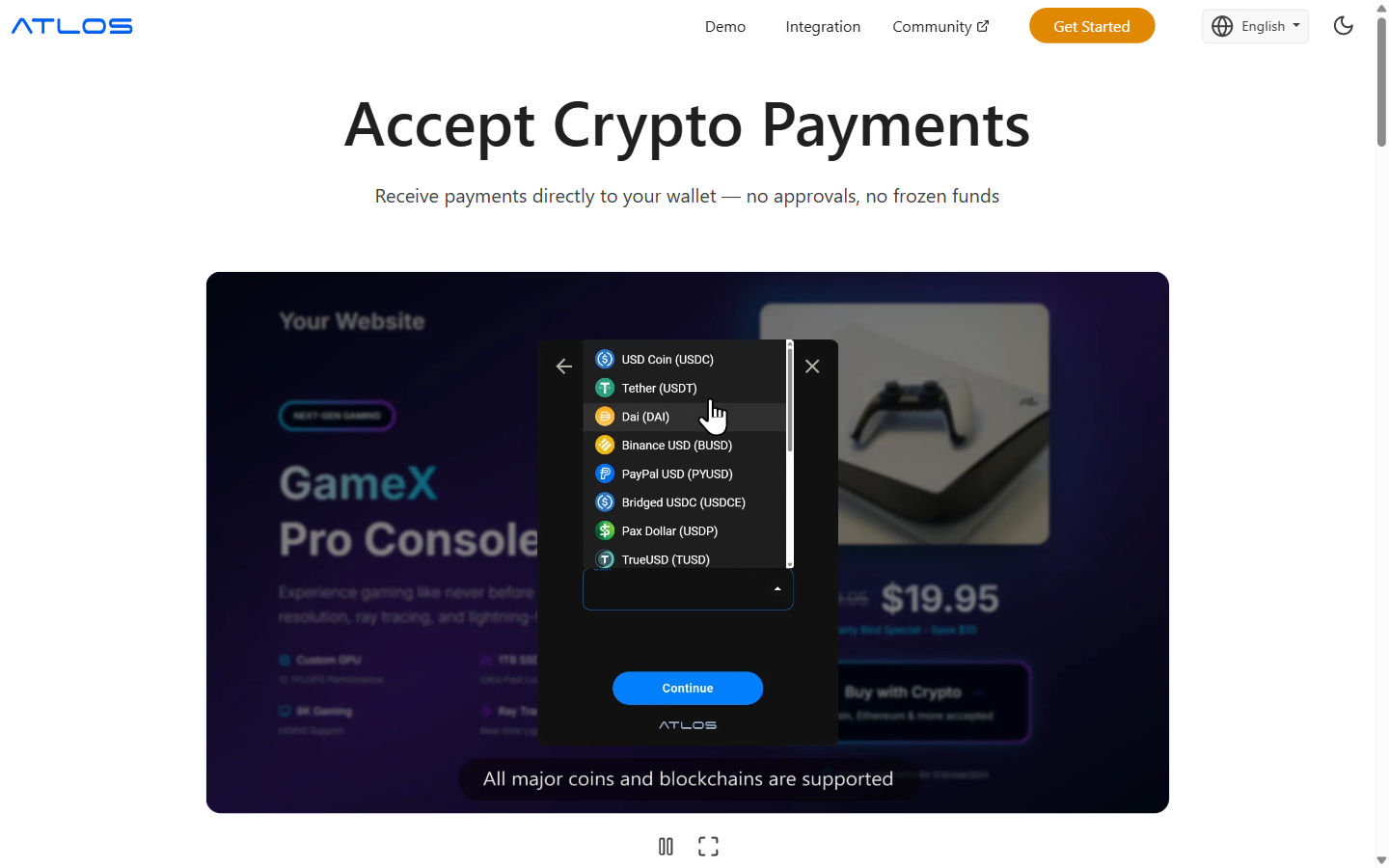
ATLOS is the closest thing to "BTCPay Server but managed." It is non-custodial (funds go directly to your wallet), requires no KYC, and supports 11 blockchain networks including Ethereum, BSC, Polygon, Arbitrum, Optimism, and Avalanche. The DAO governance model means no single entity controls the platform.
At 0.4% per transaction, it is more expensive than BTCPay Server (0%) but cheaper than most centralized alternatives. The L2 support is a significant advantage — you can accept USDC on Arbitrum or Polygon with gas fees under $0.01, making micro-transactions viable.
Why it is #2: Non-custodial with managed infrastructure, best L2/multi-chain support, DAO-governed, no KYC.
3. Coinremitter — Lowest Managed Fees
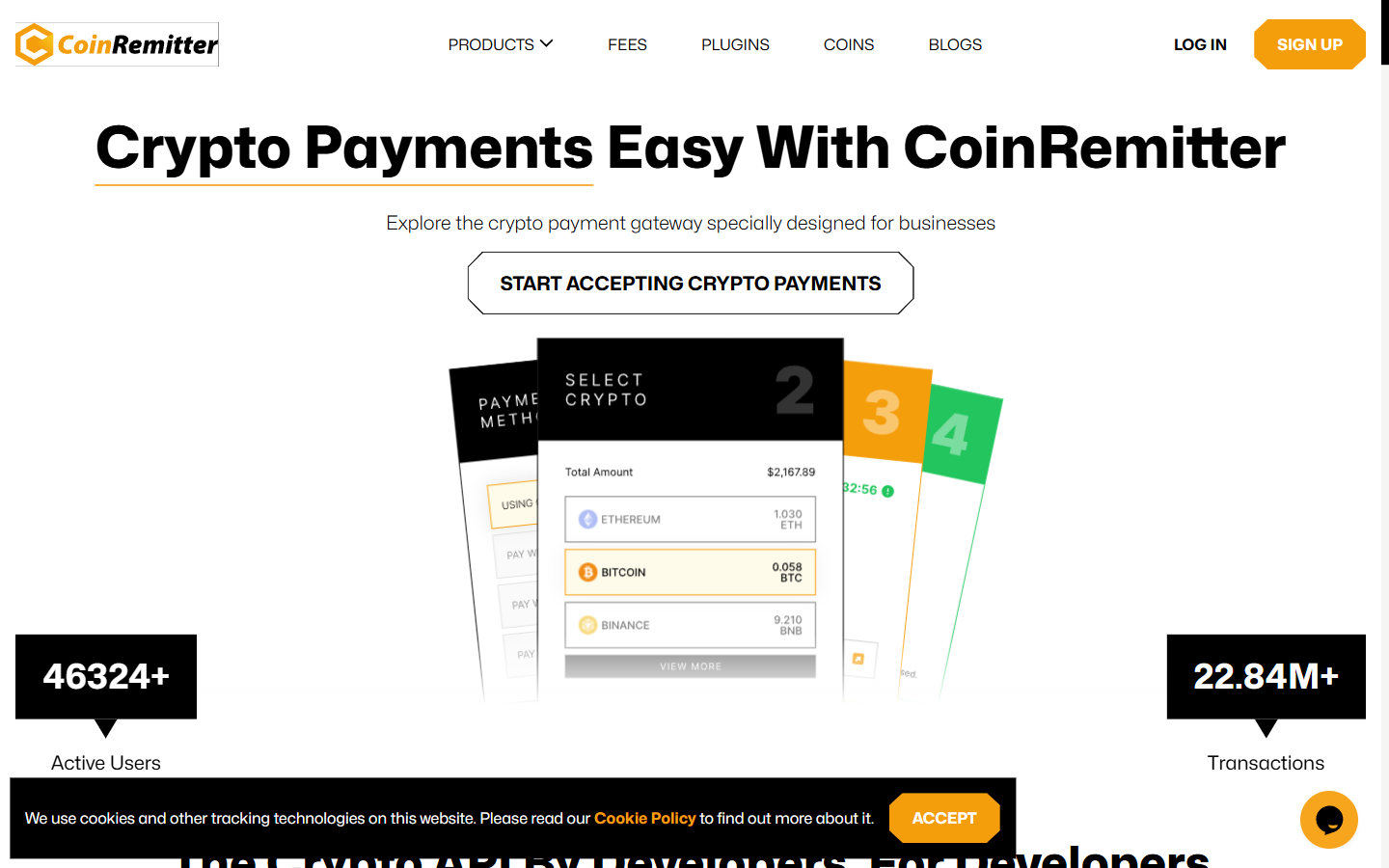
Coinremitter offers non-custodial payment processing at just 0.23% — the lowest fee of any managed gateway. It supports 50+ cryptocurrencies, requires zero KYC, and provides a clean API for integration. Funds go directly to your wallet; Coinremitter never holds your crypto.
They also run one of the most generous affiliate programs in the space: 30% lifetime commission on referred merchants' transaction fees. If you are building a community around crypto payments, this adds up.
Why it is #3: Lowest managed gateway fees, non-custodial, 50+ coins, strong affiliate program.
4. PayGate.to — Zero Registration Required
PayGate.to takes the permissionless concept to its logical extreme: you do not even need to create an account. Enter your wallet address, generate a payment widget, embed it on your site. That is it. No email, no registration, no KYC. See our non-custodial gateway comparison for full details.
At 0.5% per transaction, the fee is reasonable for the level of privacy and simplicity you get. The trade-off is limited features — no invoicing, no subscription billing, no dashboard analytics. PayGate.to is pure payment processing, nothing more.
Why it is #4: Literally zero registration, fully non-custodial, maximum privacy.
5. Paymento — Web3 with Buy Now Pay Later
Paymento is a non-custodial gateway that adds an unexpected feature: crypto buy-now-pay-later (BNPL). Customers can split crypto payments into installments, which is unusual in the Web3 space. At 0.5% fees with no KYC, the core payment processing is solid.
The coin support is more limited (7+ coins) compared to Coinremitter or ATLOS, but covers the major ones: BTC, ETH, USDT, USDC, BNB, and a few others.
Why it is #5: Non-custodial with unique BNPL feature, no KYC, but limited coin selection.
Centralized vs Decentralized: The Real Differences
The Web3 vs centralized debate is not just philosophical — it has practical consequences for your business.
The bottom line: Web3 gateways are better if you prioritize sovereignty, privacy, and censorship resistance. Centralized gateways are better if you need fiat settlement, managed compliance, and polished billing features. Many businesses use both — a non-custodial gateway for crypto-native customers and a centralized gateway for customers who want to pay with crypto but receive fiat confirmation and receipts.
Smart Contract Payments
The next frontier for Web3 payment gateways is smart contract-based payment processing. Instead of a gateway company facilitating the transaction, a smart contract on Ethereum (or another chain) handles the entire flow: price calculation, payment verification, and fund routing.
How Smart Contract Payments Work
- A merchant deploys a payment contract (or uses a shared contract from the gateway)
- The contract generates a unique payment ID for each transaction
- The customer sends crypto to the contract with the payment ID
- The contract verifies the amount, deducts the gateway fee (if any), and forwards funds to the merchant's wallet
- Both parties can verify the transaction on-chain
This is more decentralized than even BTCPay Server because there is no server to manage — the smart contract is the infrastructure. ATLOS is moving in this direction with their DAO governance, and several newer projects are building fully on-chain payment rails.
Current Limitations
Smart contract payments are still early. Gas fees make them impractical on Ethereum mainnet for small transactions (paying $5 for a coffee should not cost $3 in gas). L2 networks like Arbitrum, Optimism, and Base bring gas fees under $0.01, making smart contract payments viable. Expect this space to mature significantly through 2026 and 2027.
Multi-Chain Support and L2 Networks
If you are choosing a Web3 gateway in 2026, multi-chain support is not optional — it is essential. Your customers hold crypto on different chains, and forcing them to bridge assets just to pay you is a terrible user experience.
Here is what good multi-chain support looks like:
- Ethereum mainnet — For large transactions where gas fees are proportionally small
- Arbitrum / Optimism / Base — Ethereum L2s with sub-cent gas fees. Best for everyday payments
- Polygon (PoS) — Very low fees, widely supported by wallets and exchanges
- BSC (BNB Chain) — Popular in Asia, low fees, large user base
- Solana — Sub-second finality, very low fees. Growing payment ecosystem
- Bitcoin (including Lightning) — Still the most widely held crypto. Lightning makes it viable for payments
ATLOS leads on multi-chain with 11 supported networks including most major L2s. BTCPay Server is Bitcoin-focused but supports Lightning for instant, cheap payments. Coinremitter supports 50+ coins but mostly on their native chains.
How to Choose a Web3 Gateway
Here is my decision framework:
- You are technical and want maximum sovereignty: BTCPay Server. Zero fees, open source, self-hosted. The gold standard
- You want non-custodial without managing servers: ATLOS (best multi-chain) or Coinremitter (lowest fees)
- You want zero registration and maximum privacy: PayGate.to. No account needed, just your wallet address
- You want non-custodial with BNPL: Paymento. Unique in offering installment payments on a non-custodial platform
- You need fiat settlement: You need a centralized gateway like BitPay or CoinGate alongside your Web3 gateway. True Web3 gateways do not convert to fiat
Find Your Web3 Gateway
Compare non-custodial, decentralized payment gateways side by side. Your keys, your funds, your rules.
Compare Web3 GatewaysFrequently Asked Questions
What is a Web3 payment gateway?
A Web3 payment gateway is a non-custodial, permissionless payment processing solution that settles transactions directly on-chain. Unlike centralized gateways (BitPay, CoinGate), Web3 gateways never hold your funds. Payments go directly from the customer's wallet to yours, with the gateway only facilitating the transaction.
Is BTCPay Server really free?
The software is free and open-source. You pay only for hosting (a VPS costs $5-15/month on DigitalOcean or Luna Node) and network transaction fees (which the customer typically pays). There are zero processing fees — BTCPay Server takes no percentage of your sales.
Can a Web3 gateway freeze my funds?
No. Non-custodial gateways never hold your funds, so there is nothing to freeze. Payments go directly to your wallet. Even if the gateway company shuts down or the platform goes offline, your received payments are already in your wallet and unaffected.
Do Web3 gateways support fiat settlement?
Generally no. Converting crypto to fiat requires a licensed financial intermediary, which contradicts the non-custodial, permissionless nature of Web3. If you need fiat settlement, use a centralized gateway like BitPay or CoinGate alongside your Web3 gateway.
Which Web3 gateway has the lowest fees?
BTCPay Server has zero processing fees (you only pay for hosting). Among managed gateways, Coinremitter at 0.23% is the cheapest. ATLOS charges 0.4%, and PayGate.to and Paymento charge 0.5%.
Are Web3 payment gateways legal?
Using a non-custodial payment gateway is legal in most jurisdictions. However, you are still responsible for tax reporting on income received, regardless of the payment method. Some countries have specific regulations around crypto businesses — consult local regulations and a tax professional.
What is the difference between non-custodial and decentralized?
Non-custodial means the gateway does not hold your funds. Decentralized means no single entity controls the platform. BTCPay Server is both: non-custodial and decentralized (open source, self-hosted). ATLOS is non-custodial and partially decentralized (DAO governance). Coinremitter is non-custodial but centralized (the company runs the platform).
Can I accept NFT payments with a Web3 gateway?
Standard Web3 payment gateways process fungible token payments (BTC, ETH, USDT, etc.), not NFTs. For NFT-based payments or token-gated commerce, you would need a specialized solution. Some developers build custom smart contracts that accept NFTs as payment, but this is not a standard feature of any gateway listed here.